
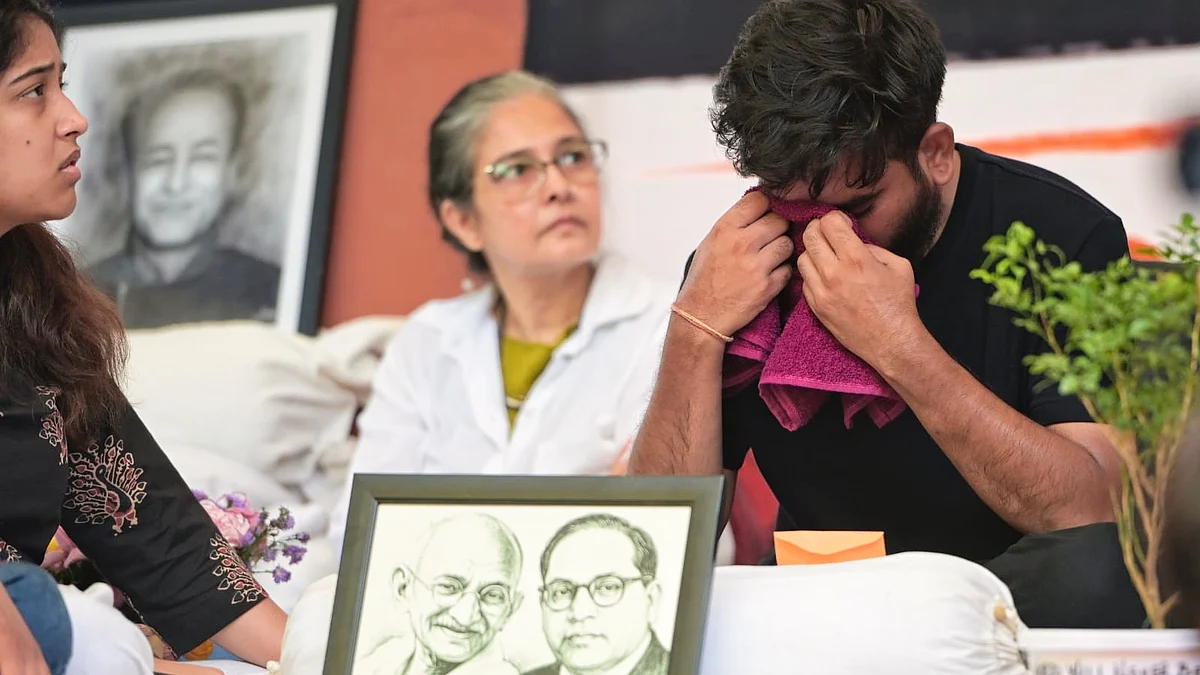
On 25 July, Dharmendra Pradhan resigned as Union Education Minister. Seven weeks earlier, almost nobody in Delhi had heard of the Cockroach Janta Party, a name born out of a throwaway insult from the Chief Justice about jobless youth and social media loudmouths. By late July the CJP had shut down parts of central Delhi, put Sonam Wangchuk on a hunger strike at Jantar Mantar, and extracted a cabinet resignation from a government that has made a habit of never giving one.
Credit where it is due. That is a real win, and India’s formal opposition has not managed anything like it in twelve years.
The question now is what comes next, and here the mood in the commentary pages runs well ahead of the arithmetic. Movements that win a scalp and movements that win power are usually two different animals. The first needs anger, a good hashtag and a photogenic sit-in. The second needs a programme, a machine, and about 272 seats.
Consider what a government campaign van can put on its side panel. Operational airports have roughly doubled since 2014, from 74 to around 165. National highways have grown 61 percent, from 91,287 km in FY14 to 146,566 km by March 2026, with the four-lane-and-better network going from 18,371 km to 45,516 km. Metro rail has expanded from 248 km to more than 1,155 km across 26 cities. Rural tap water connections went from 3.23 crore households in 2019 to 15.86 crore by June this year. Foreign exchange reserves, which stood at $314.9 billion when this government took office, crossed $728 billion in March.
Those reserves are not an abstraction, and the fuel pump is where people feel it. Petrol in India runs between roughly ₹95 and ₹107 a litre depending on which state you fill up in. In Pakistan it has touched PKR 393, about ₹142, with rationing reported in several provinces. Nepal went from NPR 137 in January to NPR 219 by April. Sri Lanka, buying on the spot market, has been hit just as hard. India got through the same Hormuz disruption on diversified sourcing and a strategic cushion. Voters who remember 2013 understand what that cushion is worth.
Then there is the part of the record that sits most awkwardly with the protest itself. India had 387 medical colleges before 2014. As of the National Medical Commission’s July seat matrix, it has 823. MBBS seats went from 51,348 to 1,36,939, and 63,296 of those are in government institutions where a poor family can actually afford the fees. Postgraduate seats more than doubled to 74,306. AIIMS campuses grew from seven to twenty, with six more under construction.
And NEET, for all the damage this year’s leak has done to it, is what makes those seats reachable. Before 2016, private colleges ran their own entrance exams, and everyone in the system knew what that meant for a bright student without a chequebook. One national paper is the reason a candidate in Darbhanga sits the same test as a candidate in South Delhi.
Which brings us to the movement’s real weakness. The 3 May paper was cancelled, arrests followed, a CBI probe is running. That is a National Testing Agency failure, an administrative one, and a bad enough failure that a minister has now paid for it. But it is not an argument against the seat expansion, and the CJP has not said what it would put in NEET’s place.
Nor has it said much else. The demands were a resignation, compensation of ₹1 crore for the families of the roughly 20 students who died, and an inquiry. Every one of those is defensible. But there is no position paper on how to secure an examination attempted by 2.27 million people. Nothing on shifting reservation towards an income test, which is the reform most likely to help the exact students standing in that crowd. Nothing on a uniform civil code. A movement can run on grievance for a season. It cannot govern on one.
The Dhaka and Colombo comparisons are doing more work than the facts allow. Those uprisings happened over sovereign default, empty fuel stations and currency collapse. India’s macro position is the mirror image. Bangladesh has 17 crore people, Sri Lanka 2 crore, Nepal 3 crore. India has 145 crore spread across 543 constituencies, and a crowd at Jantar Mantar simulates none of the coordination that winning those seats demands.
The honest counterweight is that the government blinked, and quickly. Human Rights Watch documented baton charges, tear gas and internet shutdowns on 20 July, and you do not deploy that against a nuisance. Graduate unemployment is real and no airport count answers it. The 2024 result showed this majority is conditional. The CJP is three months old, and calling its ceiling now is a guess dressed up as analysis.
In conclusion, the students have proved they can make Delhi flinch, which is more than Rahul Gandhi achieved by camping outside the Prime Minister’s residence on 21 July, and more than a decade of personalised attacks on Modi has ever delivered at the ballot box. But flinching is not the same as falling. To become a political force rather than a July memory, the CJP has to do the boring work its founders have so far avoided: pick a position on exam reform, on reservation, on the civil code, and defend it through an election cycle when the cameras have gone. Anger got them a minister. Only a programme will get them anything more, and on present evidence they do not have one.
Leave a Reply