
India does not need another political party simply to add another symbol to an already crowded ballot paper. It needs something far more difficult to build: a political movement capable of changing what citizens expect from politics itself.
For decades, Indian elections have repeatedly returned to familiar territory, poverty, caste, religion, identity, subsidies and political loyalty. These are not imaginary issues. Poverty remains real. Social inequality remains real. Religious tensions can have serious consequences.
But there is a fundamental difference between addressing these problems and continuously using them as electoral instruments.
A country of India’s scale, ambition and demographic strength cannot keep discussing the future almost entirely through the vocabulary of the past.
The next political conversation should be about empowerment.
It should ask why a child’s access to quality education can still depend heavily on the income of his or her parents. It should ask why families remain terrified that one serious illness could destroy decades of savings. It should ask why district hospitals, government schools, public transport systems, municipal services and ageing infrastructure often receive less political attention than identity-based arguments.
It should ask a more uncomfortable question too: what has happened to the relationship between citizens, government and the private sector?
Healthcare is perhaps the clearest example.
India’s private healthcare sector has built world-class hospitals, attracted talented doctors and expanded access to advanced treatment. It has also filled gaps where public healthcare has been unable to meet demand.
But for many ordinary families, entering a private hospital has increasingly become a financial decision almost as much as a medical one.
There is a growing perception that the system sometimes rewards revenue generation more strongly than patient care. Families worry about expensive investigations, procedures, room charges, medicines and prolonged hospitalisation. Whether every individual complaint is justified is not the larger point.
The larger issue is that trust is weakening.
A patient entering a hospital should believe that the first question being asked is, “What treatment does this person need?”
Too many families fear that somewhere in the system another question is also being asked: “How much revenue can this patient generate?”
When citizens begin thinking this way, the problem is no longer confined to one hospital or one company. It becomes a governance problem.
The same concern appears in other sectors.
Private education can become so expensive that quality learning feels increasingly like a premium product. Housing in major cities moves beyond the reach of ordinary salaried families. Insurance policies become difficult to understand precisely when customers need them most. Essential services can become complicated packages of charges, conditions and exclusions.
The answer is not to attack private enterprise.
India needs private investment, entrepreneurship, competition and wealth creation. No modern economy can grow without them.
But markets need rules.
A successful country is not one where government controls every business. Nor is it one where government simply watches while essential services become unaffordable.
The role of government is to create intelligent regulation, enforce transparency, protect consumers and ensure that sectors such as healthcare and education continue serving a social purpose alongside a commercial one.
This is precisely where a new political movement could be different.
Instead of promising only another subsidy, it could ask how to reduce the reason the subsidy became necessary.
Instead of announcing another health scheme, it could ask why treatment costs are rising.
Instead of promising free education, it could ask whether students are actually learning.
Instead of announcing another pension programme, it could build a serious national conversation around retirement security for informal workers.
Instead of celebrating kilometre counts, it could measure the quality, safety and maintenance of roads.
Instead of talking endlessly about employment numbers, it could ask whether young Indians have the skills required for the jobs of 2035.
Welfare has an important role. A civilised state must protect people who are poor, elderly, sick, disabled or temporarily unable to support themselves.
But welfare should be a safety net, not the final destination of politics.
The real measure of political success should be how many people eventually need less assistance because they have acquired better education, stronger skills, stable employment, affordable healthcare and opportunities to build wealth.
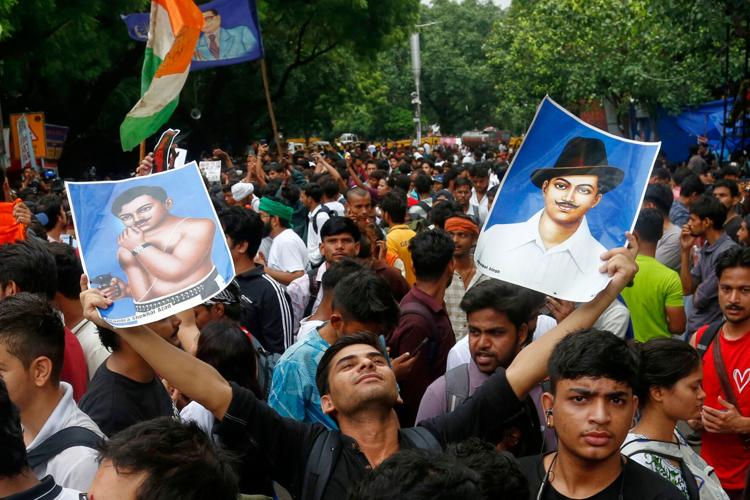
This is why recent Gen Z political energy has attracted attention.
Young Indians are impatient. They are connected to the world, exposed to technology and less willing to accept institutions simply because previous generations did.
That creates hope.
But youth itself is not a political philosophy.
A generation that can produce viral videos in minutes still needs to understand economics, history, constitutional institutions, public finance, agriculture, healthcare, manufacturing, geopolitics and technology.
India does not merely need young protesters. It needs young policy thinkers.
Anger can fill a street. It cannot run a ministry.
Social media can expose a problem. It cannot design a national healthcare system.
India experienced similar optimism when the anti-corruption movement created space for the Aam Aadmi Party. Many people believed a new political model had arrived.
Over time, however, the realities of electoral politics demonstrated how difficult it is to remain fundamentally different once an organisation enters the same competitive political ecosystem.
That experience offers an important warning.
Creating a new party is easy compared with creating a new political culture.
A genuine movement should therefore avoid defining itself primarily as anti-BJP, anti-Congress, anti-AAP or anti-anyone else.
Opposition alone is not vision.
Its politics should be built around measurable national priorities: quality public education, affordable healthcare, modern hospitals, scientific research, entrepreneurship, advanced manufacturing, urban planning, environmental sustainability, pension security, efficient courts, better policing and infrastructure that works.
Candidates should be valued for competence rather than surname, caste arithmetic, religious appeal or their ability to command crowds.
Political debates should increasingly resemble job interviews.
What have you built?
What have you improved?
What did it cost?
What result did citizens receive?
And what will you do differently?
India’s next political transformation may not begin with a charismatic leader standing on a giant stage.
It may begin when citizens stop asking politicians what they will give them and start asking what kind of country they intend to build.
After nearly eight decades of independence, perhaps India’s most important political question is no longer simply who represents which caste, religion, region or community.
It is something much larger:
Can Indian politics move from managing people’s insecurities to expanding their possibilities?
If a new political movement can answer that question seriously, India may not merely get another party.
It may finally get a different kind of politics.
Leave a Reply